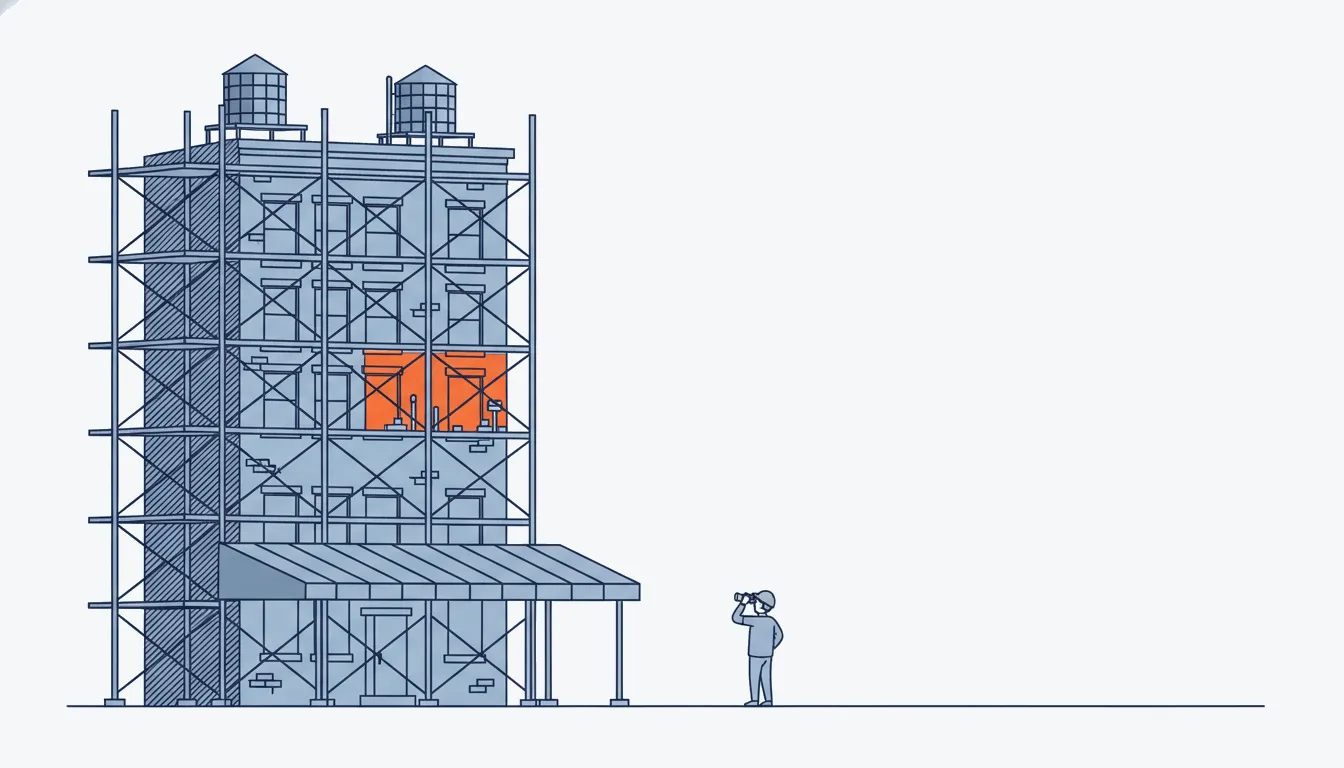
Local Law 11 is New York City’s facade inspection law. If a building is taller than six stories, its owner must hire a qualified engineer or architect to inspect the entire facade every five years and file the results with the Department of Buildings. The program’s official name is the Facade Inspection & Safety Program, or FISP; most people in the industry still call it Local Law 11, after the 1998 law that gave it its current shape.
The law exists because facades fail. It was written in response to falling masonry killing pedestrians, and everything about it follows from that: the inspections are mandatory, the classifications are public, and the deadlines have teeth.
Who has to comply
Every building in NYC higher than six stories falls under FISP, with narrow exceptions for walls set far back from any area people can walk. That covers roughly 12,000 to 16,000 buildings across the five boroughs, from pre-war co-ops on the Upper West Side to office towers in Midtown. The obligation sits with the owner, but in practice the filing is managed by the building’s managing agent, and the inspection is performed by a Qualified Exterior Wall Inspector (QEWI), a licensed engineer or architect registered with DOB.
How the five-year cycles work
FISP runs in numbered five-year cycles, and each cycle is split into staggered sub-cycles (A, B, C) based on the last digit of a building’s block number, so the whole city doesn’t file at once. The current cycle, Cycle 10, opened in February 2025 with its first sub-cycle filing windows. What matters for anyone reading filings: at any given moment, thousands of buildings are inside an open filing window, and every one of them must produce a fresh engineer’s report before that window closes.
Each report classifies the facade into exactly one of three categories.
What does SWARMP mean in a facade inspection report?
SWARMP stands for Safe With a Repair and Maintenance Program. It is one of the three classifications a Qualified Exterior Wall Inspector can assign to a building facade in a New York City Local Law 11 (FISP) report. A SWARMP classification means the engineer found real defects, cracked brick, deteriorated mortar joints, spalling concrete, failing lintels, or loose coping stones, that are not an immediate danger to the public today, but that must be repaired before the building’s next five-year filing.
In practice, a SWARMP filing is an engineer-certified list of required masonry repairs with a legal deadline attached. The building is safe to occupy now. It is not compliant indefinitely.
SAFE, SWARMP and UNSAFE: what the classifications mean
SAFE means the inspector found no conditions threatening people or property. The building files and moves on for five years.
SWARMP stands for Safe With a Repair and Maintenance Program. This is the category that matters most, and the least understood. A SWARMP filing means the engineer found real defects, cracked brick, deteriorated mortar joints, spalling concrete, failing lintels, loose coping stones, that are not an immediate hazard yet, but must be repaired before the next cycle’s filing. If the work isn’t done by then, the building cannot file SAFE and typically tips into UNSAFE. In other words: a SWARMP filing is a written, engineer-certified list of masonry repairs with a multi-year but hard legal deadline attached.
UNSAFE means a condition threatens public safety right now. The owner must put up protection (the sidewalk sheds New York is famous for) immediately and repair the condition promptly, with the shed staying up, and shed rental fees running, until the work passes re-inspection. UNSAFE buildings accrue monthly civil penalties until the condition is corrected, on top of the shed costs, which is why UNSAFE owners are usually the most motivated buyers of restoration work in the city.
Failing to file at all carries its own escalating DOB penalties, so even reluctant owners eventually enter the system.
Why every filing is a lead for masonry and restoration work
Read those three categories again from a contractor’s point of view.
A SWARMP building is a client whose scope of work has already been written by a licensed engineer, whose deadline is set by law, and whose alternative to hiring someone is sliding into UNSAFE status with penalties and a sidewalk shed. There is no “do they need the work” question. The only open question is who gets hired.
An UNSAFE building is the same thing compressed in time: mandated scope, active penalties, shed fees accumulating every month the owner waits.
And because FISP filings are public records, the entire pipeline is visible: which buildings filed SWARMP, which conditions were cited, which deadlines apply, and which buildings are approaching a filing window with a repair list still open from last cycle. Add the newer Local Law 126 parapet requirement, which since 2024 obliges owners of buildings fronting the public right-of-way to have their parapets inspected every year, and the city produces a continuous stream of fresh, documented masonry defects, most of them at buildings under six stories that FISP never touched.
The same logic now extends beyond New York. New Jersey’s Structural Integrity Act puts masonry and concrete condo buildings statewide on a legal inspection clock at 15 years of age, with engineer reports that mandate repairs, a different statute producing the same kind of documented obligation.
What this means in practice for a masonry contractor
Most facade restoration work in NYC is won one of two ways: a relationship with the managing agent, or being the first credible company to reach the owner after the classification lands. The filings tell you which buildings are in which state; city registration records tell you which management company runs each building and how large its portfolio is (the building owner lookup and HPD registration lookup read those records for any address). Put together, that’s a list of accounts, management companies and owners, not homeowners, where an engineer has already documented the need, the law has already set the deadline, and the money is already being forced into motion.
The same public-record layer feeds adjacent trades: parapet and roof-edge work overlaps with roofing, and the violation stream that drives facade work runs on the same machinery as NYC heat violations for HVAC.
That is exactly the layer FieldClients works: we monitor the filings, complaints and ownership records daily, match each one to the account behind the building, and route each lead, with a verified decision-maker email and a company phone where listed, to a single masonry member in a capped market.
Want the buildings in your market that just filed SWARMP, went UNSAFE, or entered a filing window, with the management company and a verified contact attached? That’s what a FieldClients masonry membership delivers.