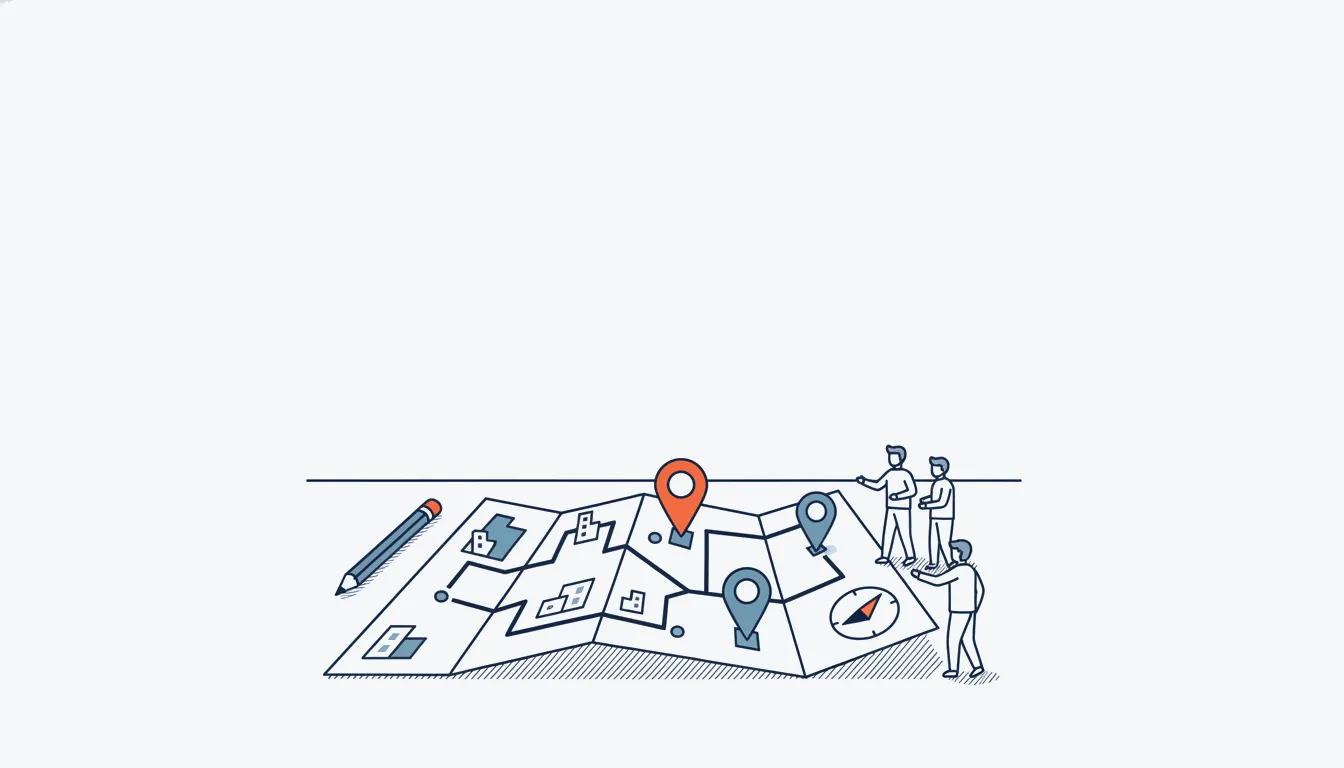
The field service growth stack has one axis that organizes every channel: whether it wins you homeowner jobs or commercial accounts. Get that axis right and the rest of home services marketing becomes a budgeting exercise. Homeowner-job channels, Google Local Services Ads, paid search, reviews, and word of mouth, capture people who already have a problem and are searching right now. Commercial-account channels, signal-based sourcing, direct outreach, and SEO, win management companies, building owners, and portfolios before they ever type a query. Most companies over-invest in the first group, ignore the second, and wonder why revenue stays lumpy. This guide maps the full stack across every trade, tells you what each channel actually costs and returns, and shows where the recurring-revenue accounts hide.
The one axis that organizes the stack
A homeowner job is a transaction. A furnace dies, a homeowner searches, someone shows up, the job closes, and the relationship usually ends there. A commercial account is a relationship. A property management company with 40 buildings needs HVAC service, plumbing repairs, roof inspections, and cleaning on a recurring basis, and once you are the vendor of record you keep that revenue for years.
The two require different marketing. Homeowner-job channels are built around search intent. You pay to be visible at the moment of need. Commercial-account channels are built around timing and access. You reach the decision-maker at a business before the need becomes a search, because by the time a portfolio owner is Googling “commercial HVAC near me,” three vendors already quoted.
Field service companies that scale past the owner-operator ceiling do it on accounts, not jobs. A single management-company relationship can be worth more in a year than 50 homeowner calls, and it does not evaporate when your ad budget pauses. That is the strategic reason the commercial side of the stack deserves real budget, and it is the side almost everyone underfunds.
There is a second reason. Homeowner demand is cyclical and weather-driven, a mild winter or a slow storm season can cut residential volume in half with no warning. Account revenue is contracted and recurring, so it smooths the trough. Companies that survive slow seasons are the ones whose account book covers fixed costs while the homeowner channels catch back up. The stack, read correctly, is a hedge as much as a growth engine.
The channel matrix
Every channel in home services marketing trades off cost, speed, and which outcome it produces. Here is the full stack in one view.
| Channel | Cost | Timeline | Residential outcome | Commercial outcome | Effort |
|---|---|---|---|---|---|
| Google Local Services Ads (LSAs) | $ per lead, pay-per-lead | Days | Strong, high-intent homeowner calls | Weak, rarely reaches account decision-makers | Low |
| Paid search (Google Ads) | $$ per click | Days to weeks | Strong for urgent jobs | Moderate for named commercial terms | Medium |
| Local SEO / Google Business Profile | Time + $ | 3–9 months | Strong, compounding | Moderate | Medium |
| Website SEO (pillar + trade pages) | $$ upfront | 6–12 months | Moderate | Strong for “commercial [trade]” terms | High |
| Reviews & reputation | Time | Ongoing | Strong, closes homeowner trust | Moderate | Low |
| Referral / word of mouth | Low | Ongoing | Strong but unpredictable | Strong within a portfolio | Low |
| Direct mail / door hangers | $$ | Weeks | Moderate, declining | Weak | Medium |
| Social + community | Time | Months | Moderate brand | Weak direct | Medium |
| Bought marketplace leads (shared) | $$ per lead | Days | Weak, resold, discounted | Weak | Low |
| Signal-based B2B sourcing | $$ per routed lead | Days to weeks | N/A | Strong, targets accounts before they search | Low (done for you) |
| Direct outreach (email + phone) | Time or $$ | Weeks | Weak | Strong for accounts | High |
Read the two outcome columns as separate businesses. LSAs and reviews dominate the residential column and barely register on commercial. Website SEO, direct outreach, and signal-based sourcing dominate commercial and do little for one-off homeowner volume. A complete stack funds one strong channel in each column and stops there, six half-funded channels beat none of them.
Homeowner-job channels, briefly
If your revenue is mostly residential, start with Google Local Services Ads. You verify the business, set a weekly budget, and pay per lead rather than per click. The Google Guaranteed badge sits above the paid results and converts on trust. Pair it with paid search for terms LSAs do not cover and for controlling your own landing pages.
Underneath the ads, local SEO and your Google Business Profile compound for free over months. Fill out the profile completely, post regularly, and drive reviews relentlessly, reviews are the single highest-leverage residential asset because they close the homeowner who is comparing three companies. Aim for a steady drip of recent reviews rather than a one-time push; recency and volume both feed the ranking, and a review from last week reads as more trustworthy than one from two years ago.
Two channels round out the residential floor and rarely deserve heavy budget: direct mail still works in dense residential markets but the response rates keep sliding, and social and community presence builds slow brand recognition without producing measurable jobs on its own. Fund them only after the intent channels are maxed. None of these, however, builds the account book. They capture demand that already exists. For that reason we treat them as the floor of the stack, not the ceiling, necessary for cash flow, insufficient for scale.
Notes by trade
The stack is universal, but the mix shifts by trade. Each trade below has a dedicated marketing guide and a live lead feed.
HVAC. Highest residential search volume of any trade and the strongest LSA economics, but the money compounds on commercial service contracts and management-company accounts. See the HVAC marketing guide for the channel-by-outcome breakdown, and the HVAC lead feed for accounts sourced from equipment-age and violation signals.
Roofing. A volume game on the residential side, storms drive spikes, and an account game on the commercial side, where a single portfolio of flat roofs is worth dozens of homeowner replacements. The roofing marketing guide covers residential volume versus commercial accounts, and the roofing lead feed surfaces permit and inspection signals.
Plumbing. Emergency intent makes LSAs and paid search efficient, but recurring revenue lives in building accounts. The plumbing marketing guide is about winning those accounts; the plumbing lead feed routes violation and registration signals.
General contractors and remodelers. Longer sales cycles and larger tickets mean SEO and referral matter more, and permit signals identify projects early. Start with the contractor marketing guide and the contractor lead feed.
Commercial cleaning. Almost entirely an account business. One property manager unlocks a whole portfolio of buildings on recurring contracts. Signal sourcing beats intent channels badly here. See the commercial cleaning lead feed.
Electrical. Residential service work fills the schedule; commercial tenant fit-outs and building accounts carry the margin. Permit and registration signals flag both. See the electrical lead feed.
Waste removal. A recurring-contract business at its core. New construction permits, business registrations, and property transfers signal accounts that need service before they shop for it. The homeowner channels barely apply. This trade lives or dies on the account book, which makes signal sourcing the primary channel rather than a supplement.
Fire protection. Inspection cycles and code violations are the signal. Compliance deadlines create predictable, recurring demand across every commercial property in a market. One of the cleanest signal-to-account fits in field service. A violation for a missing or expired system names the building, the owner, and the deadline, which is close to a pre-qualified account handed to you before anyone else acts on it.
How to sequence the build
Channels do not all get turned on at once, and the order matters. Build the stack in three moves.
First, secure cash flow. Turn on the one homeowner-job channel with the fastest payback for your trade, LSAs for most, paid search where LSA inventory is thin, and get your Google Business Profile and reviews working. This funds the payroll while everything else matures.
Second, start the compounding assets early even though they pay off late. Website SEO and account acquisition take months to move, so the worst time to start is when you finally need them. Publish trade-specific pages, and stand up a signal-based account source so the pipeline is filling while your rankings climb.
Third, prune and reallocate on data. After 90 days you will have per-channel cost-per-closed-client numbers. Cut whatever sits at the bottom, and move that budget into whatever sits at the top. Repeat every quarter. The stack is never finished. It is a portfolio you rebalance, not a setup you complete.
The commercial-account channel most companies skip
Here is the channel almost no field service company runs, and the one that produces the highest-LTV accounts: signal-based sourcing.
Every commercial account passes through the public record before it needs you. A building files a permit. A property gets cited for a violation. A new LLC registers to operate a portfolio. A management company changes the agent of record on a filing. Ownership transfers. Each of these is a signal, a documented, timestamped event that says a specific business is about to need field service, named, with an address, before that business runs a single search.
Intent channels cannot touch this. LSAs and paid search only fire after the business searches, by which point it is comparing quotes. Signal-based sourcing works the opposite way: it monitors permits, code violations, business registrations, and agent-of-record changes across a market, matches each event to the company behind it, and routes the account to you with contact details attached, a verified email on every lead, and a company phone where listed.
That is the difference between this and buying shared marketplace leads. A marketplace lead is a homeowner form resold to four competitors who all call at once. A signal-based B2B lead is a specific business, a management company, an owner, a portfolio, identified at the moment its situation changed, routed to you before competitors act. The value is exclusivity and timing, not the word lead.
The economics follow from the exclusivity. When four companies buy the same homeowner form, three of them lose the job and eat the cost, so the true price of a marketplace lead is far higher than the sticker. A routed account with a triggering event and contact details attached goes to one company. You are not bidding against a crowd on a phone that is already ringing four times. You are the first, and often the only, call. For an account business that difference compounds every month, because each account you win early is one a competitor never gets a shot at.
For an account business, this is the highest-leverage channel in the stack, and it is the one most companies never build because assembling permit feeds, violation records, and registration data across a market is genuinely hard. That is the work FieldClients does, the sourcing runs continuously, and you receive routed accounts instead of building the plumbing yourself.
Measurement: cost per closed client
Most home services companies measure the wrong number. Cost per lead is easy to pull and nearly useless, because a $15 shared marketplace lead that closes 3 percent of the time costs more per client than a $200 signal-based account lead that closes 20 percent. The number that matters is cost per closed client, and for commercial you extend it to cost per account relationship, because an account keeps paying.
Work it backward. Take channel spend, divide by leads to get cost per lead, then divide by your close rate to get cost per closed client. Do it per channel, not blended, blended numbers hide which channel is carrying the business. Then layer in lifetime value. A homeowner job might be worth $400 once. A management-company account might be worth $30,000 a year for five years. A channel that looks expensive per lead can be the cheapest per dollar of lifetime revenue, and only per-account math reveals it.
Track three numbers per channel: cost per closed client, average first-year value, and retention. A channel earns more budget when cost per closed client falls or lifetime value rises. Everything else is vanity.
Two attribution traps distort these numbers. The first is crediting the last touch, an account you sourced from a permit signal in March may not sign until June after two follow-ups and a referral, and if you credit the referral you will defund the channel that actually started the relationship. Tag the first touch and hold it. The second is ignoring account expansion. A management company that starts with one building and grows into twelve should credit all twelve to the channel that landed the first, because that is the real return on the acquisition. Measure the account, not the invoice.
Budgeting by company size
Marketing budget should scale with revenue and shift in mix as you grow.
Under $500K revenue (owner-operator). Run 10–15 percent of revenue. Keep it simple: LSAs or paid search for homeowner cash flow, a complete Google Business Profile, and relentless review collection. Add one signal-based account source to start building recurring revenue that does not depend on ad spend.
$500K–$2M (small team). Run 8–12 percent. Now split deliberately by outcome. Fund one fast homeowner channel and one compounding commercial channel. This is the stage where the account book should start carrying real weight, because homeowner jobs alone cannot support a growing crew through a slow season.
$2M–$10M (established). Run 6–10 percent. Website SEO and a named account-acquisition motion matter now. Signal-based sourcing should be a standing line item, feeding a sales process that closes management companies and portfolios. Measure every channel on cost per closed client and prune the losers.
$10M+ (multi-market). Run 5–8 percent, weighted toward compounding assets, SEO, brand, and account acquisition at scale across markets. At this size the homeowner channels are table stakes; growth comes from winning accounts faster than competitors across every market you operate in.
The pattern holds at every size: fund one homeowner-job channel for cash flow and one commercial-account channel for compounding revenue, measure both on cost per closed client, and move budget toward whatever lowers it.
Where to start
If your residential channels already work, your gap is almost certainly the commercial-account side of the stack, the recurring, higher-LTV revenue that signal-based sourcing produces and intent channels never reach. That is the channel most of your competitors skip. See the contractor lead feed for accounts sourced from permits, violations, and registrations in your market, routed with a verified decision-maker email on every lead and a company phone where listed.