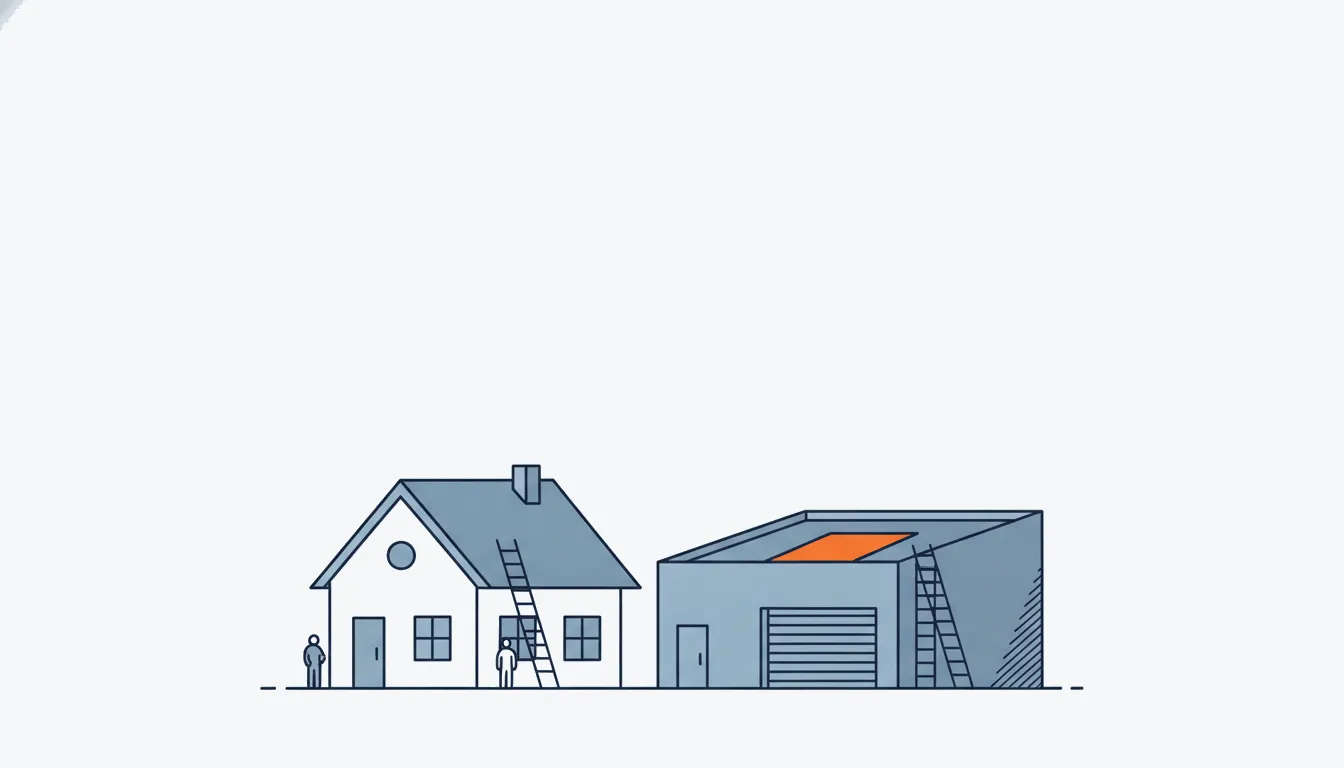
A roofing company is two businesses wearing one truck wrap. One is residential storm and replacement volume: a homeowner searches after a hailstorm, you inspect, you close within days, the job is worth a few thousand dollars and it is over. The other is commercial portfolio reroof accounts: a management company or building owner with a book of aging flat roofs, where one relationship turns into years of scoped work across dozens of buildings. These two businesses do not share a marketing playbook. Residential volume responds to ad spend and speed. Commercial accounts respond to relationships and timing. Pick the wrong channel for the outcome you want and you will burn budget filling the wrong funnel. This guide splits the two and shows which channel feeds which, plus the public signals that surface commercial reroof work before the RFP is written.
The two outcomes, side by side
Before you spend a dollar, be clear on what a “lead” is worth to you. The gap between a residential job and a commercial account is not incremental. It changes which channels make sense.
| Factor | Residential storm / replacement | Commercial portfolio reroof |
|---|---|---|
| Buyer | Homeowner | Management company, building owner |
| Decision speed | Days | Months, sometimes a year |
| Job value | $4,000–$25,000 | $80,000–$500,000+ per building |
| Repeat work | Rare | Portfolio-wide, multi-year |
| Trigger | Storm, visible damage, age | Filing, permit, capital planning cycle |
| Best channels | Paid search, LSA, referral | Signals, outbound, relationships |
Residential is a volume game measured in cost per lead. Commercial is a relationship game measured in cost per account. Confusing the two is the most common budget mistake in roofing marketing.
Channel table: cost, timeline, outcome
Every channel does one thing well. Here is what each costs, how fast it produces, and which business it actually feeds.
| Channel | Cost to start | Time to first lead | Feeds |
|---|---|---|---|
| Google Local Services Ads | $$ per lead, pay-per-lead | Days | Residential volume |
| Paid search (Google Ads) | $$$ per click, rising in storm season | Days | Residential volume |
| SEO / local content | $$ ongoing | 4–9 months | Both, mostly residential |
| Google Business Profile + reviews | Low, time-heavy | Weeks | Residential volume |
| Door-knocking after storms | Labor cost | Immediate | Residential volume |
| Referral / insurance-adjuster network | Relationship time | Months | Both |
| Signal-based B2B sourcing | Flat per-lead | Days | Commercial accounts |
| Outbound to management companies | Rep time + data | Weeks | Commercial accounts |
| Buying shared lead lists | $$ per shared lead | Immediate | Residential volume only |
Notice the split. Almost every fast, ad-driven channel feeds residential. Commercial accounts sit at the bottom, and they do not respond to ads because the buyer is not searching. The buyer is a portfolio manager working a capital plan, and you reach that person through data and outreach, not a keyword bid. See buying leads vs sourcing them for why shared lists cap out at residential volume.
The storm-season demand curve
Residential roofing demand is not flat. It spikes with weather and collapses between events. A single hail or wind event can 10x inbound calls in a metro for two to six weeks, then demand falls back to baseline. Paid-search costs move with that curve: click prices climb exactly when every roofer in the market is bidding, so your cost per lead is highest precisely when volume is highest.
This creates a trap. Companies staff and spend for the peak, then carry that overhead through the trough. The demand you can see is the demand every competitor can see too. Put numbers on it: a metro that averages 60 residential inquiries a month can hit 600 in the two weeks after a major hail event, then fall to 40 through the winter. If your cost structure assumes 600, the other ten months bleed. If it assumes 40, you leave the storm on the table. Neither works alone.
The fix is not to abandon storm work. It is to stop depending on it. Two moves:
- Bank the storm, build the base. Use peak-season cash to fund channels that produce in the trough, SEO content that ranks year-round, a review engine on your Google Business Profile, and a referral loop with adjusters and property managers.
- Add a counter-cyclical line of business. Commercial reroof accounts do not follow the residential storm curve. A portfolio manager replaces a 1985 flat roof because it is at end of membrane life, not because it hailed last Tuesday. That demand is steady, plannable, and invisible to the roofers fighting over storm clicks. It is where home services marketing maturity separates a storm chaser from a durable book of business.
Commercial reroof signals: reach the account early
Commercial work has a tell. The decision to reroof a portfolio leaves a public trail weeks or months before an RFP goes out. Track the trail and you are the relationship, not the third quote. The signals that matter:
- Facade / LL11-type filings. A required facade-inspection filing (Local Law 11 in NYC, equivalents in other cities) lands on a building. Facade and roof work travel together, and the filing names the building and the responsible party.
- Roof age flags. Records surface portfolios of flat roofs built in an era now due for replacement. A 1980s membrane is at the end of its typical life. The owner already knows it is coming, and a scoped conversation is welcome, not an interruption.
- Reroof permits by block. A roofing permit filed near buildings you could serve signals age and weather exposure across the neighbors. One approved roof on a block is territory in play.
- Storm-affected portfolios. Filings and complaints cluster across an owner’s buildings after a storm event. That is insurance-driven urgency across multiple buildings at once, a portfolio conversation, not one job.
- Managing-agent changes. A building or portfolio changes managing agent. A new agent reassessing capital needs is the exact moment a reroof program gets scoped.
None of these show up in a lead list you can buy off the shelf, and none of them appear in a keyword report. They come out of the public record, matched to the account behind the building. That is what a commercial roofing leads program is built on, and it is the reason signal-based sourcing beats every ad channel on cost per commercial account.
The timing is the whole point. A facade filing or a roof-age flag surfaces weeks to months before a portfolio manager solicits bids. Reach the account in that window and the first conversation is a scoped assessment, not a price war. Wait until the RFP is public and you are one of five roofers responding to a spec written by whoever got there first. Every signal above is a chance to be that first roofer. The play is simple: watch the record, match the signal to the responsible party, and open with the building, not a pitch, while the owner is still deciding what the project even is.
Budget guidance by company size
Spend should track the business you are building, not a flat percentage pulled from a trade forum. Rough allocations:
Owner-operator, under $1M revenue. Budget 6–8 percent of revenue. Put most of it into a Google Business Profile and review engine plus Local Services Ads for residential volume. Keep one channel for commercial: a small signal feed and a few hours a week of outreach. You cannot afford to chase RFPs blind, so let the data tell you which owner to call.
Established residential, $1M–$5M. Budget 8–10 percent. Paid search plus LSA carry storm-season volume. Fund SEO to survive the troughs. Carve out 15–20 percent of the marketing budget to start a real commercial line, signal sourcing plus a dedicated rep, because your residential ceiling is a treadmill and commercial is the way off it.
Commercial-focused or hybrid, $5M+. Budget 5–7 percent, weighted away from ads. At this size, one commercial account is worth hundreds of residential jobs, so the money goes to data, outbound, and relationship building. Ads become a supplement for residential capacity, not the engine.
The pattern: the bigger and more commercial you get, the less a click-based channel earns you, and the more a signal-based one does. A useful gut check, if more than 80 percent of your marketing spend produces work that ends when the job ends, you are running one business when you could be running two.
Worked numbers: cost per closed client
Cost per lead is a vanity number. What matters is cost per closed client, and it exposes how differently the two businesses behave. Here is a realistic side-by-side.
| Metric | Residential (paid search, storm season) | Commercial (signal-based sourcing) |
|---|---|---|
| Cost per lead | $110 | $90 |
| Leads to reach one close | 14 | 7 |
| Cost per closed client | $1,540 | $630 |
| Average job / account value | $9,000 | $140,000 (first year) |
| Marketing cost as % of that value | 17% | 0.5% |
The residential lead is slightly cheaper per unit and converts worse, because you bought it at the same time as four competitors during the peak. The commercial lead costs less per close and unlocks an account worth 15x more, because you reached the owner early against far less competition. Both businesses are worth running. But if you only measure cost per lead, you will over-invest in the one that looks cheap and never build the one that pays.
Run this math on your own numbers before your next budget cycle. Pull your true close rate per channel, multiply lead cost by leads-to-close, and compare against the lifetime value of what each channel actually produces. The channel that wins on cost per lead almost never wins on cost per closed client.
Two measurement habits keep this honest. First, tag every closed job with the channel that sourced it, not the last touch, the phone call that closed a commercial account traces back to a filing you acted on months earlier, and last-click attribution will credit the wrong thing. Second, measure the commercial line on account lifetime value, not first job. A portfolio reroof that starts with one building rarely ends there; the second and third buildings carry almost no acquisition cost, which is exactly why the commercial cost-per-close in the table above understates the real return once the account matures.
Where to start
If you are already running residential volume, your fastest gain is not another dollar into storm-season clicks. It is opening the commercial line the ad channels cannot reach. That starts with the public signals, facade filings, roof-age flags, permits by block, storm-affected portfolios, managing-agent changes, matched to the account and delivered with verified email on every lead and a company phone where listed.
See B2B roofing leads to reach commercial reroof accounts before the RFP is written.