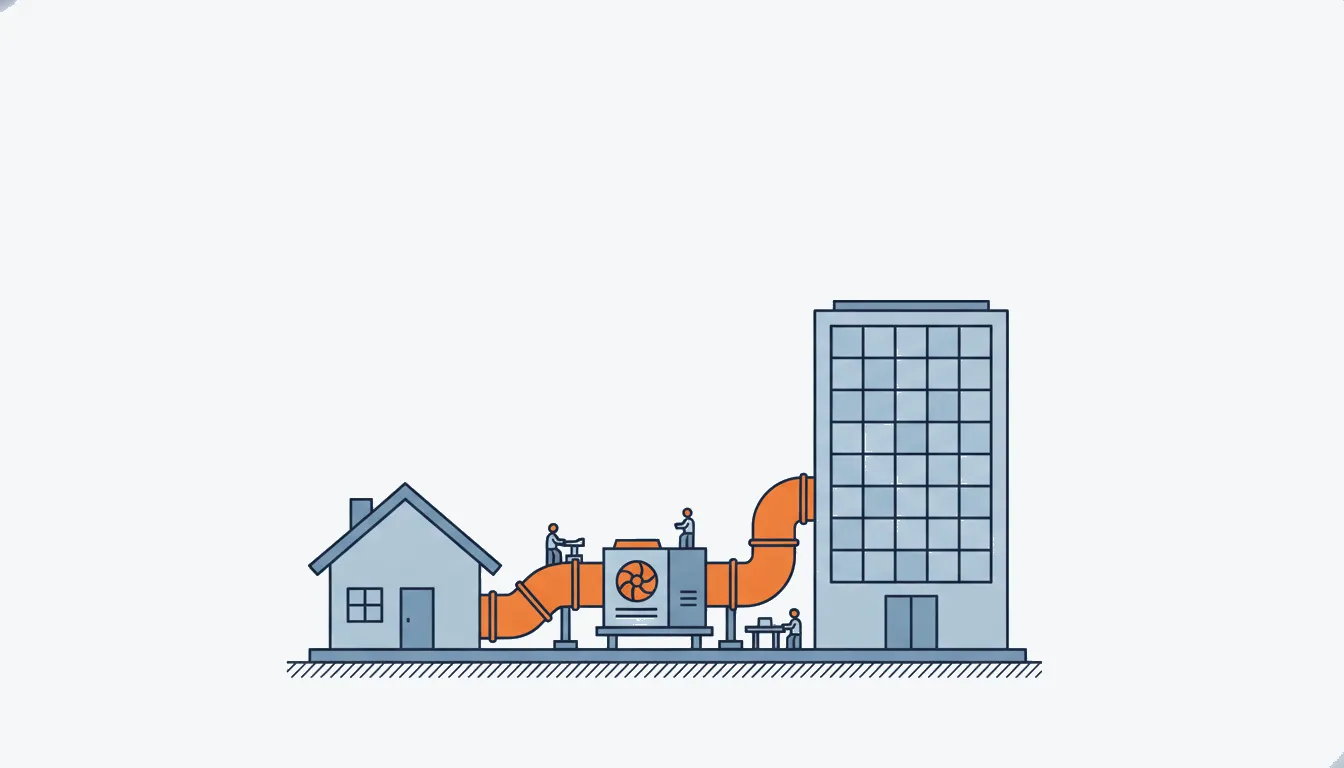
There are two businesses inside every HVAC company, and most marketing budgets are built as if there were one. The first is residential volume: homeowners with a dead compressor in July, paying 320 dollars for a repair or 9,000 for a changeout, once, then gone for six years. The second is commercial accounts: property managers, building owners, and portfolio operators who sign recurring maintenance and route every replacement your way. The channels that feed the first business are not the channels that feed the second. If you want commercial accounts, the honest answer is that Local Services Ads and review platforms will not get you there, and the channel that will is one almost nobody runs.
This guide splits every HVAC marketing channel by outcome: which ones produce homeowner jobs, and which ones produce commercial accounts. Then it shows how to budget between them at three revenue stages.
The two businesses, in numbers
A residential job is a transaction. A commercial account is a relationship with a lifetime value.
| Factor | Residential job | Commercial account |
|---|---|---|
| Buyer | Homeowner | Property manager, owner, portfolio |
| Typical first ticket | 150 to 9,000 dollars | 1,200 to 40,000 dollars |
| Repeat cycle | Every 4 to 7 years | Monthly or quarterly, indefinitely |
| Decision speed | Same day | 2 to 8 weeks |
| What you are buying | A job | An LTV stream |
Competitors that sell you leads are selling the left column: one homeowner, one job, often shared with three other contractors who got the same phone number. FieldClients sources the right column. That distinction runs through every channel below.
Run the arithmetic on lifetime value. A residential customer who buys a 320-dollar repair, returns once in six years, and eventually pays for a 7,000-dollar changeout is worth roughly 7,600 dollars over that window, most of it arriving in a single event you may or may not still be the vendor for. A commercial account paying 1,100 dollars a month in maintenance across a small portfolio, plus two replacements a year at 8,000 dollars each, is worth over 29,000 dollars annually and renews. One is a lump you chase again in six years. The other is a stream you bank every month. Marketing that ignores the second is leaving the larger number on the table.
Channel guide, split by outcome
Here is what each channel actually costs, how long it takes to produce revenue, and which of the two businesses it feeds.
| Channel | Cost to start | Time to first revenue | Feeds resi job | Feeds commercial account |
|---|---|---|---|---|
| Google Local Services Ads | 30 to 90 dollars per lead | Days | Yes | No |
| Google Search / PPC | 8 to 25 dollars per click | 1 to 3 weeks | Yes | Rarely |
| Organic SEO | 1,500 to 5,000 dollars per month | 4 to 9 months | Yes | Some |
| Review platforms (Google, Yelp, Nextdoor) | Free to 350 dollars per month | Weeks | Yes | No |
| Shared lead marketplaces | 25 to 75 dollars per lead | Days | Yes | No |
| Referrals / existing customers | Low | Ongoing | Yes | Yes |
| Direct sales / list outreach | Rep salary | 1 to 4 months | No | Yes |
| Signal-based B2B sourcing | Per-lead or subscription | Days | No | Yes |
Read the two right-hand columns. Six of the eight channels feed homeowner jobs. Only three feed commercial accounts, and two of those (referrals, direct sales) are slow or headcount-heavy. That leaves one repeatable, fast channel pointed at the commercial column, and it is the one most HVAC companies have never run.
The homeowner-job channels
Local Services Ads are the fastest way to fill a residential schedule. You pay per lead, Google’s badge sits at the top, and the phone rings the same day. It is efficient for volume and useless for portfolios. Property managers do not click the “Google Guaranteed” badge to award a 40-building maintenance contract.
Search and PPC capture intent: someone typing “AC repair near me” is ready to buy a job. Bid on it. But commercial buyers rarely search that way, and when they do, they are price-shopping a single site, not sourcing a vendor for a portfolio.
SEO is the compounding play. It is slow and it is worth it for the residential side and, done right, for a slice of the commercial side too. If you want to understand when ranking beats buying leads, see HVAC SEO. SEO builds an asset; the paid channels rent one.
Review platforms are table stakes for homeowners and nearly irrelevant for commercial procurement. A building owner checks whether you carry the right insurance and can service 30 rooftop units on a schedule, not your Yelp stars.
The commercial-account channels
Referrals are the highest-quality commercial channel and the least controllable. One happy property manager introduces you to two more. Excellent margins, zero predictability, no volume dial.
Direct sales works if you can afford a rep. A salaried closer knocking on property-management doors builds real accounts, but the cost is a salary before the first contract signs, and the rep spends most of the week finding who to call rather than calling.
That “who to call” problem is exactly what the last channel solves.
The commercial-account channel almost nobody runs
Signal-based sourcing points marketing at a documented, dated event that means a specific business needs HVAC work now.
A new mechanical permit filed on a commercial building. An open heat or code violation on a managed property. A change in the management agent on a portfolio, which almost always triggers a vendor review. A boiler or rooftop unit passing 20 years in a building of record. Each of these is a public, dated signal that a business, not a homeowner, has a reason to talk to you this month.
This is the opposite of a shared homeowner lead. It is never a purchased list. Every lead carries a specific reason to call and the date that reason appeared, plus a verified decision-maker email on every lead and a company phone where listed. Your rep opens with the event, not a pitch: “I saw the heat violation filed on your Elm Street property on the 3rd.” That is a different conversation than a shared marketplace lead who got four other calls in the same hour.
Because the buyer is a business, one closed relationship can carry a portfolio. Win the management company and you win every building it runs, plus the recurring maintenance that turns HVAC from job-to-job into predictable monthly revenue. That is the mechanics behind HVAC maintenance contracts, and it is why the math is not comparable to buying homeowner jobs. See why buying shared leads underperforms for the full contrast.
Three signals do most of the work in HVAC. A management-agent change is the strongest: when a portfolio switches operators, the new team almost always re-bids mechanical vendors within 90 days, and the incumbent contractor rarely sees it coming. Open heat and code violations are the most urgent: a documented violation carries a deadline and a fine, which means the property manager needs a compliant vendor this week, not this quarter. Aging equipment of record is the most predictable: a rooftop unit or boiler that crosses 20 years in a permitted building is a replacement waiting to be scheduled, and the owner is budgeting for it whether or not you call. Each signal tells your rep not just who to call, but exactly why the call is timely.
The operational advantage is that this channel replaces the slowest, most expensive part of direct sales: research. A salaried rep who would otherwise spend three days a week finding accounts instead opens each morning to a list of businesses with a dated, documented reason to hear from you. The same headcount closes more because the top of the funnel is qualified before the first dial.
Budget splits by revenue stage
The right mix shifts as you grow. Below are starting points, not laws.
At 1 million dollars in revenue, you are proving the machine and you need cash flow now. Weight toward homeowner-job channels that pay this week, but reserve a slice for one or two commercial accounts, because a single portfolio can reset your trajectory.
- Local Services Ads and PPC: 55 percent
- SEO: 20 percent
- Signal-based B2B sourcing: 20 percent
- Referral incentives: 5 percent
At 5 million dollars, residential is a working system and commercial is where growth compounds. Shift budget into the account column.
- Local Services Ads and PPC: 35 percent
- SEO: 20 percent
- Signal-based B2B sourcing: 30 percent
- Direct sales support and referrals: 15 percent
At 15 million dollars, you are a commercial-first operation defending residential rather than chasing it. The account column carries the business.
- Local Services Ads and PPC: 25 percent
- SEO: 15 percent
- Signal-based B2B sourcing: 35 percent
- Direct sales team and referrals: 25 percent
Notice the pattern: as you scale, marketing does not simply grow, it moves. Absolute spend on homeowner acquisition can flatten because each new commercial account replaces dozens of one-off jobs.
Measurement: cost per closed client, not cost per lead
Cost per lead is the wrong number because it treats a homeowner repair and a 30-building account as the same unit. They are not. Measure cost per closed client, and attribute the full lifetime value of the account to the channel that produced it.
Here is the same 5,000-dollar monthly budget run two ways.
| Factor | Homeowner-job channel | Commercial-account channel |
|---|---|---|
| Monthly spend | 5,000 dollars | 5,000 dollars |
| Cost per lead | 50 dollars | 140 dollars |
| Leads per month | 100 | 36 |
| Close rate | 20 percent | 25 percent |
| Closed clients | 20 | 9 |
| Cost per closed client | 250 dollars | 556 dollars |
| Avg first-year value per client | 340 dollars | 14,000 dollars |
| First-year revenue produced | 6,800 dollars | 126,000 dollars |
| First-year return on spend | 1.1x | 21x |
The homeowner channel looks cheaper on every per-lead line and produces a fraction of the revenue. The commercial channel costs more than twice as much per closed client and returns roughly 21 times spend in year one, before the recurring maintenance and replacements that follow in years two through six. If you had judged these on cost per lead, you would have picked the wrong one.
The residential channel is not bad. It fills trucks, funds payroll, and keeps techs busy between big contracts. But if your marketing report only shows cost per lead, you are optimizing the smaller of the two businesses inside your company and starving the larger one.
Where to start
Keep running the homeowner-job channels that pay this week. Then add the one channel pointed at the commercial column that you can actually turn into a dial: signal-based sourcing. A documented, dated reason to call a specific business, with a verified decision-maker email on every lead and a company phone where listed, is the difference between buying jobs and building accounts.
See B2B HVAC leads for the commercial-account channel most companies skip.