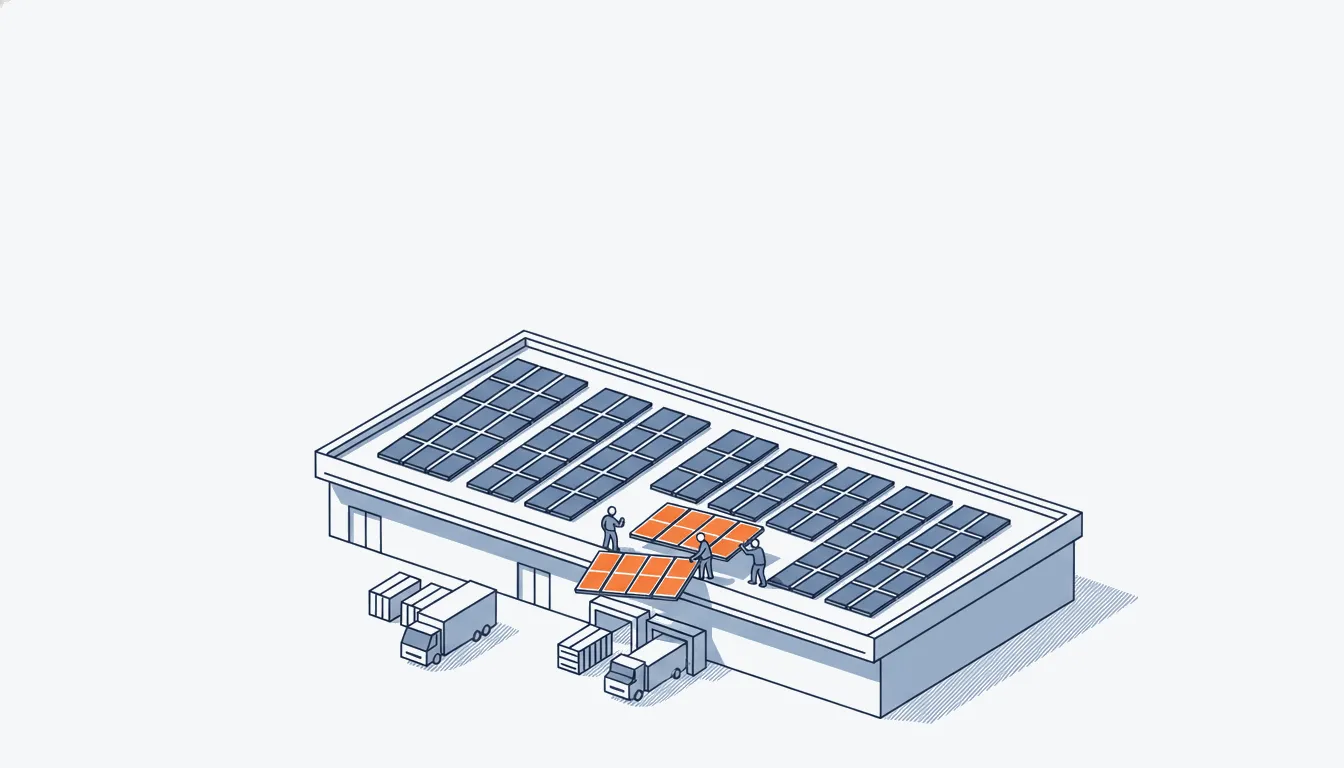
Commercial solar leads are found, not bought, and the finding happens in the public record before any RFP exists. A C&I solar project announces itself months ahead: the re-roof permit that precedes almost every rooftop array, the planning application, the interconnection queue entry, the new distribution center breaking ground, the energy-intensive tenant signing a lease under a quarter-million square feet of flat roof. Each event names a building and dates itself, and the installer who reaches the owner at that stage competes with nobody, while the installer who waits for the RFP competes with everyone. The purchased-lead alternative is priced accordingly: commercial solar carries some of the highest costs per click in the industry, roughly $100 and up, because vendors price against six-figure projects.
This is the same pre-RFP playbook as commercial roofing, one trade over, and the two literally share a signal: the roof.
The market, honestly
Residential solar contracted hard after the 25D credit expired: installs down roughly 18 to 21 percent, acquisition costs up around 40 percent, third-party ownership absorbing share. C&I is where the durable demand sits, the 48E commercial credit survived, demand-charge and hedging economics hold without a household tax credit, and the buyers are organizations. The honest trade-off is time: C&I sales cycles run quarters, so the pipeline discipline in this guide matters more than any single lead.
The signals, ranked by how early they fire
| Signal | Where it appears | What it means | Lead time before an RFP |
|---|---|---|---|
| Re-roof permit on a large flat roof | Permit records | The classic pre-solar event: nobody panels a roof with 5 years left | 6 to 24 months |
| New industrial construction start | Permits, planning filings | 48E-driven builds spec solar early or leave it roof-ready | 12+ months |
| Planning or zoning application mentioning solar | Planning dockets | Intent on paper before contractor selection | 6 to 18 months |
| Interconnection queue entry | Utility queues (public in most territories) | Project real enough to file; developer or owner attached | 3 to 12 months |
| Energy-intensive tenant lease | CRE news, filings | Load appears under a big roof; landlord holds the asset | 6 to 18 months |
| Battery or EV infrastructure permits at the address | Permit records | An owner already electrifying buys the next phase | Concurrent |
The first row deserves the emphasis. A commercial re-roof is the single best commercial solar lead there is: the owner just invested in the substrate, the roof now has 20+ years of life, and the marginal case for panels will never be better. Watching large-roof permit activity is watching next year’s solar market.
Working the account before the RFP
- Lead with the building’s own event. “You just re-roofed 180,000 square feet” opens doors that “we do commercial solar” never will. The dated event is the credential.
- Bring the analysis, not the brochure. A one-page estimate of that roof’s production, demand-charge impact, and 48E treatment gives facilities and finance something to circulate internally. You are writing the memo that creates the project.
- Find the roof’s owner, not its occupant. On leased assets the landlord decides; the tenant’s load is your argument to them. Ownership records and the leasing chain name the decision-maker; verifying that person is the enrichment step that separates a signal from a name.
- Pair with the storage and VPP layer. The program landscape adds enrollment revenue and resilience framing to the same proposal, and commercial storage often unlocks projects that solar economics alone would not.
- Expect quarters, and stage the pipeline. Score every signal by roof size, event recency, and owner type, and touch the account on a quarterly cadence until the project forms. The RFP, when it finally appears, tends to go to whoever shaped it.
The feed version
Everything in the table is public, dated, and decaying: a re-roof permit is worth the most the month it is filed. FieldClients runs this watching layer as a feed, permits, planning filings, and queue entries matched to the building’s owner, with a verified decision-maker email on every lead, and a company phone where listed, routed to a capped number of members per trade and market. Solar seats open as members sign; if C&I is your lane, ask about your market and we will show you the signal volume there.