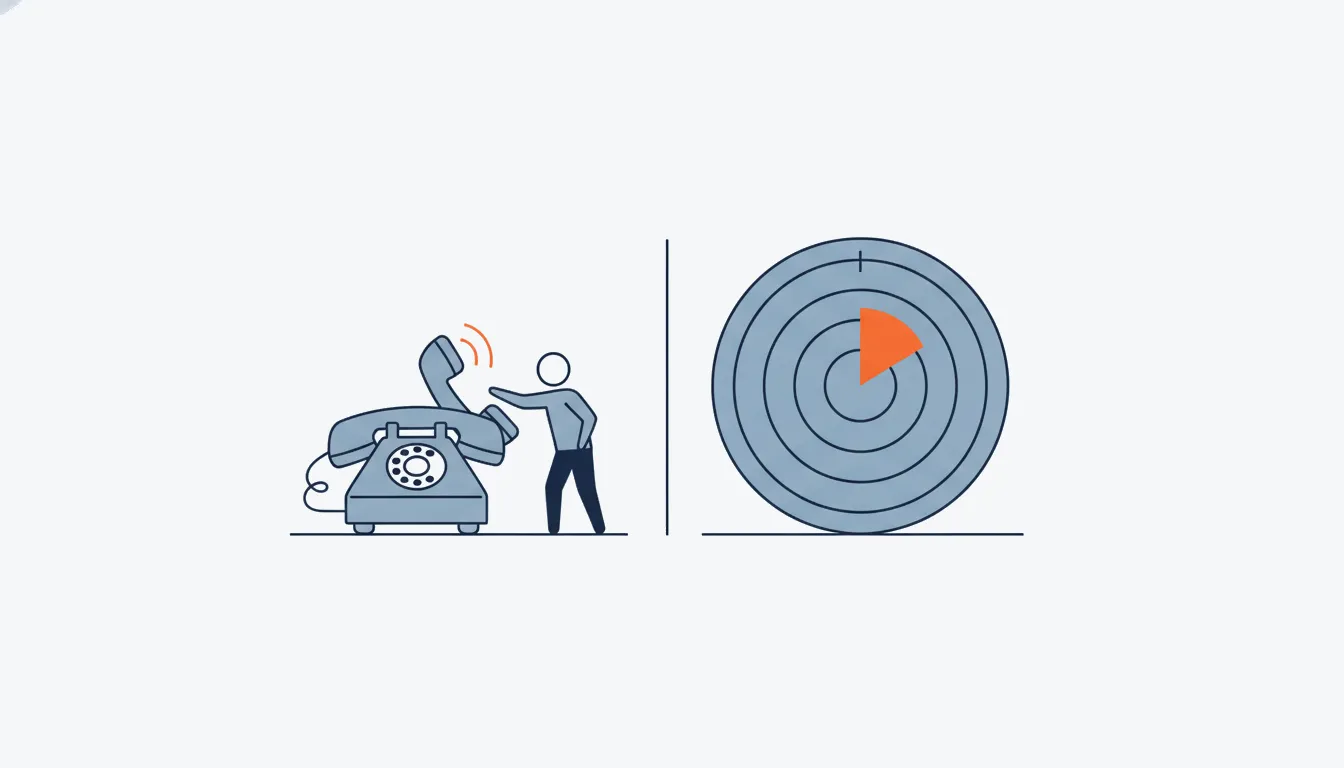
Answer first: which model fits
If your business runs on inbound residential emergencies, a burst pipe, a dead AC in July, storm damage on a roof, pay-per-call and live transfer are strong channels. They put a homeowner who wants to buy right now on your phone, and you pay only when the call connects. That is hard to beat for one-off resi jobs.
If your business runs on B2B accounts, property managers, building owners, facilities teams, businesses with portfolios and recurring maintenance, signal-based sourcing wins. Those buyers do not call ads. You find them by their situation and make the first call yourself, on a documented, dated reason.
Most contractors run some of both. The rest of this guide shows how each model actually works, what it costs per closed client, and how to split your budget so each dollar lands where it converts.
How pay-per-call and live transfer work
Both models sell you a phone call with a buyer already on the line. The difference is how the buyer gets there.
Pay-per-call. A network runs ads, search, display, social, sometimes its own directory sites. A person with a problem clicks or dials. The call routes to your business line. You pay when the call passes a minimum duration, often 60 to 120 seconds, which filters out wrong numbers and hang-ups. You are buying an inbound caller at the moment of intent.
Live transfer. Same front end, plus a screening step. An agent or an IVR asks a few qualifying questions, service type, location, timing, sometimes budget, then transfers the qualified caller to you live. You pick up and the buyer is already briefed. Live transfers cost more per call because the network absorbs the screening and the non-qualifying volume.
The real economics
Pay-per-call and live transfer shine on three things:
- Speed. A qualified caller is on your phone today, not in a nurture sequence. For emergency trades, speed to contact is the whole game.
- Buyer intent. The person called an ad about their exact problem. They want the service now.
- Pay-on-connect. You do not pay for a form fill that never answers. You pay when a human is talking.
The cost math looks like this. A qualified call runs $15 to $100+ depending on trade and market. Screened callers close on the phone at roughly 15 to 35 percent, higher than a shared form lead, because intent is high and the caller reached you directly. At a $40 call and a 25 percent close, that is about $160 per closed job. For a $600 drain-clearing or a $1,500 AC repair, the ratio works.
Where the model gets expensive: high-value emergency verticals push call prices up, some networks recycle callers across multiple buyers, and call quality varies by source. Two knobs move your real cost. First, dispute and refund terms, good networks credit you for wrong-number, out-of-area, or duplicate calls, and the difference between a network that honors disputes and one that stonewalls can swing your effective cost per call by 20 to 30 percent. Second, geographic and hours filtering, a call that comes in outside your service area or after your crew has gone home still bills if it passes the duration threshold. Tighten the routing rules before you scale spend.
You are also buying a job, not an account. The caller wants one thing fixed. When it is fixed, the relationship usually ends. You can convert a share of those callers into repeat customers, but the model itself sells single transactions. That is fine when your business is transactional resi volume. It is a ceiling when you want recurring commercial work.
How signal-based B2B sourcing differs
Signal-based sourcing inverts the flow. Instead of waiting for a buyer to call an ad, you identify businesses that have a documented, dated reason to need your service, then reach out first.
The reason comes from public records and datasets: an open code violation, equipment past its service life, a new managing agent on a multi-building portfolio, a permit filed on an adjacent system, a registered cooling tower or boiler. Each record points to a management company, owner, or business, never a homeowner searching for a quick fix.
Consider what each signal actually tells you. An open heat or plumbing violation is a legal clock ticking, the owner has to resolve it or face fines, so the urgency is real and dated. Equipment past its rated service life means a replacement decision is coming whether or not the owner has scheduled it. A new managing agent means a portfolio just changed hands and vendor relationships are up for grabs. These are not guesses about intent. They are recorded events with a timestamp, which is why the first call opens with a fact instead of a pitch.
Three things separate this from pay-per-call:
- Exclusivity. The lead goes to you, not to four contractors racing on price. You are the only one calling that building about that violation this week.
- A dated reason to call. “The city recorded an open heat violation on your property last week” is a substantive opener, not a pitch. The buyer knows the problem is real because a public record says so.
- Account lifetime value. A B2B account is a portfolio, not a job. One property manager can mean dozens of buildings and years of recurring maintenance. The account is worth 10 to 50 times a single repair.
The tradeoff is honest: this is outbound, not inbound. No one is on the phone waiting. You make the first call, and it takes a week or two of working the list to sign the first account. What you get in return is exclusivity and durable revenue instead of a one-time transaction. See buying leads: the real math for how the three models stack up on cost per closed client.
Use both, the hybrid play
These models are not rivals. They serve two different halves of most field-service businesses, and the smart move is to run each where it converts.
Run pay-per-call or live transfer for the resi emergency side. When a homeowner’s heat is out or a pipe burst, you want a live caller on the phone in minutes. Pay-on-connect keeps your risk low, and the close rate on a screened emergency caller is high. This is your fill-the-truck-today channel.
Run signal-based sourcing for the B2B account side. When you want commercial maintenance contracts, property-management portfolios, and recurring revenue, you cannot buy your way in through an ad network. Those buyers do not call ads. You source the signal, make the first exclusive call, and build an account book. This is your grow-the-business channel.
A practical split: fund pay-per-call to cover weekly capacity and cash flow, and fund signal-based sourcing to build the accounts that compound. The first keeps the lights on. The second raises the ceiling. Contractors who run one without the other either stay stuck in one-off resi churn or starve their crews waiting for outbound to mature.
The two channels also stabilize each other. Pay-per-call volume swings with ad markets, weather, and season, a mild winter can dry up emergency heating calls overnight. A signal-based account book smooths that out, because recurring maintenance contracts bill on a schedule regardless of whether the phone is ringing. When inbound is hot, your crews stay busy on jobs; when it cools, the accounts carry the base. That is why treating them as one budget with two purposes beats betting the business on either alone. For a direct comparison against shared and routed marketplaces, see FieldClients vs Angi and HomeAdvisor.
An honest note on phone coverage
Straight talk, because it decides how you work each lead. Any vendor promising a direct phone number on every lead is either padding with switchboard numbers or overstating.
Here is our formula: verified decision-maker email on every lead, company phone where listed. Every FieldClients lead carries a verified email, checked, deliverable, tied to the right contact. We add a company phone where one is listed in public or business records. Coverage varies. Some management companies and owners publish a direct line; others are reachable first by email, then by phone once you are in contact.
We do not promise a phone number on every lead, because that promise forces vendors to guess. What we promise is that the email works and the reason to call is documented, so your first touch, email or phone, lands on the right person with a real hook. Our verified contacts page spells out exactly what ships with every lead.
Worked numbers: the two models side by side
Assume you want to add 10 clients this month. Here is how each model gets you there, using mid-range figures. Signal-based numbers assume a B2B account, worth far more than a single resi job.
| Factor | Pay-per-call / live transfer | Signal-based B2B sourcing |
|---|---|---|
| Unit bought | One inbound call | One exclusive B2B account lead |
| Cost per unit | $40 per qualified call | $20 per lead |
| Exclusivity | Semi-exclusive; some recycling | Exclusive to you |
| Who’s the buyer | Homeowner, emergency | Manager, owner, business |
| Contact model | Inbound. They call you | Outbound. You call first |
| Time to first client | Same day | 1–3 weeks |
| Close rate | ~25% on the phone | ~20% to a signed account |
| Units for 10 clients | ~40 calls | ~50 leads |
| Lead/call spend | ~$1,600 | ~$1,000 |
| Cost per closed client | ~$160 | ~$100 |
| What you win | 10 one-off jobs | 10 recurring accounts |
| Revenue horizon | Single transaction | Months to years per account |
Read the last two rows together. Pay-per-call delivers speed and 10 jobs done this week. Signal-based delivers 10 accounts that keep paying. Neither number is “better” in isolation. They answer different questions. If you need cash and trucks moving now, the top model wins. If you need a book of recurring commercial revenue, the bottom one does. Run both and you cover both.
Where to start
Pay-per-call and live transfer are the right tool for inbound resi emergencies, live callers, pay-on-connect, fast. Signal-based sourcing is the right tool for B2B accounts, exclusive, documented, and recurring. Match the model to the side of your business you are trying to grow, and stop paying one to do the other’s job.
If commercial accounts are the goal, start with leads built for the first touch: verified contacts, a verified decision-maker email on every one, a company phone where listed, and a dated reason to reach out.